Showing posts with label Geography Movies. Show all posts

Monday, 5 March 2012

Atmosphere and Circulation help

Dear All


Our current topic (Climate for those who dont go to Huish!) is widely accepted to be a little bit challenging, so I thought a special blog post on how to learn about this in a different way might be appreciated. So, first of all, a recap on the most basic rules of circulation in the atmosphere, if you dont want to read, the BBC have produced a really outstanding TV show, called "Orbit" which you can watch here, I would consider this a really excellent way to spend an hour, as it makes the entire start of the module easy and is very visual. They even have a blog centre for more reading, but in the mean time:

1. The spin of the earth:

Earth spins towards the East, if you are attached to the surface (Continents, people, trees etc) then you do not feel this effect, but, for all gases and liquids, the spin of the earth to the East, deflects surface flows towards the West. Hence, all ocean currents, surface winds, hurricanes, are pushed to the west. If the earth did not have any continents, the oceanic currents would just move around the globe, from east to west, but, the continents complicate the issue, and force ocean currents to deflect North, in the Northern Hemisphere, and South, in the Southern hemisphere, along the Eastern edges of the continents.


2. The tilt of the earth:

We tilt at an angle of 23.4 degrees away from an imaginary line that is perpendicular to our orbital plane. Our tilt, or obliquity, does not alter as we move around the sun, therefore, over our summer time, we are tipped towards the sun, summer starting during the spring equinox, through to the summer solstice and on to the september equinox, when we enter winter, as we start to tip away from the sun, reaching our maximum distance, during the winter solstice, or as you may know it, as December the 22nd.

This tilt, is what brings us the seasons, and what causes the ITCZ to move over the course of the year.

3. Convection:

This really is a key concept in Earth Sciences as a whole. The basic principle, is that anything hot, rises, until it hits an impenetrable layer, at which it must split, and flow laterally along this boundary, loosing heat to its surroundings as it does so. Once cold, it must sink, as it has become more dense, it then hits another layer, and diverges, some goes back to the source of the heat (where there will be a vacuum as material is constantly rising), and some heads in the opposite direction.


You have come across this before:


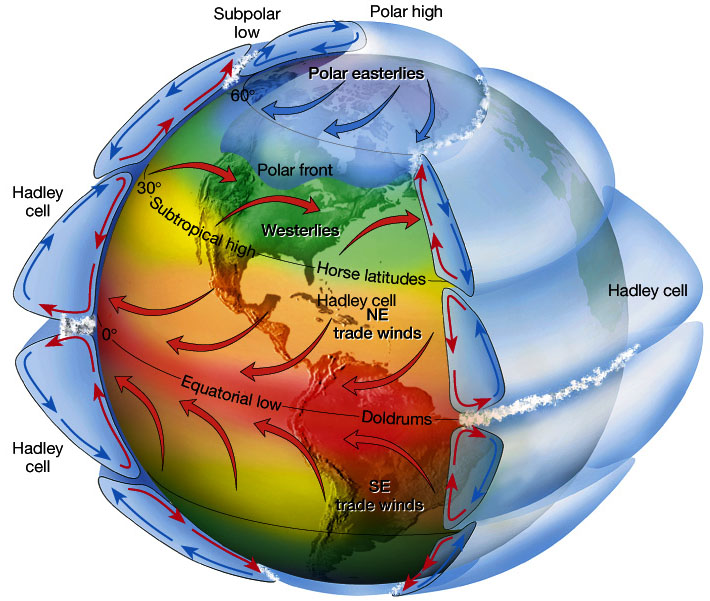
Once you factor in the 3D nature of the planet, and the atmosphere, along with the fact that we are so big, the cells are split into three, you have the global circulation model:
4. With or against Coriolis?

The Coriolis effect, is just the name we give to anything that is affected by the spin of the earth, you have come across it with tides in the Lower Sixth. The key principle to remember, is that anything that moves towards the equator, is slowed by the Coriolis effect, and therefore is always deflected to the West. If the opposite occurs, if a movement of liquid or gas moves towards a pole along the surface, it is boosted by Coriolis, and moves with the turn of the earth.

This means, that winds in the Ferrel cell, on the surface, blowing towards the poles, blow from the SW up towards the poles (Or down, if you are below the equator).


If we are talking Jet streams and Rossby waves, this difference in speed is what controls the path of Anticyclones and depressions beneath the junction between the Ferrel and the Polar cells. These regions are often referred to as the Horseback latitudes. Hence, when the meanders on the Jet stream (which we call Rossby Waves), start to head towards the equator, they are slowed, and therefore pressure builds up in the upper Atmosphere, and all the excess air has to start moving downwards, ie towards the surface, this is what is found in the ridges of the waves (Closest to the poles), whereas in the troughs, the air starts to accelerate towards to poles, leaving behind high altitude low pressure, therefore, to fill the void, air has to be sucked up from the surface, creating a low pressure system, more commonly called a depression:


Trough: pressure is lower in a trough than to the west and east
Ridge: pressure is higher in a ridge than to the west and east

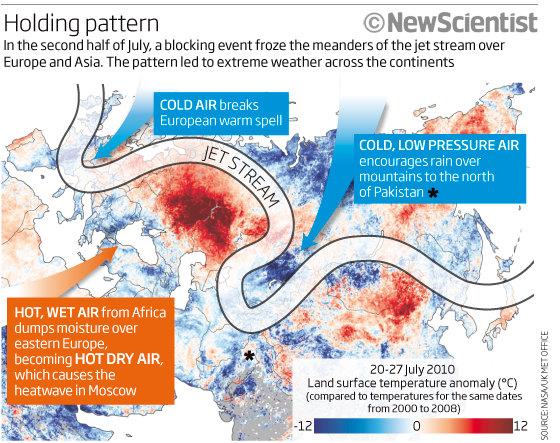


There is an excellent animation of this on the TV show recommended. This passage can sometimes get stuck, as happened in July 2008, and December 2010, as this diagram explains:


5. The ITCZ:

This is the driving force, which starts the tri-cellular model, the ITCZ stands for Inter Tropical Convergence Zone, literally, the place where the surface winds of the Hadley cell come together, and where the most intense heating of the earths surface takes place. It can easily be seen on most satellite images:


It is not a straight line, none of the boundaries between the cells are, and it moves as the earth rotates around the sun. In our winter time, it is more southerly, and over our summer time, more northerly. Where it crosses continents that sit beneath the two extremes, it causes a seasonal reversal of the winds, and this change, brings about the Monsoons:
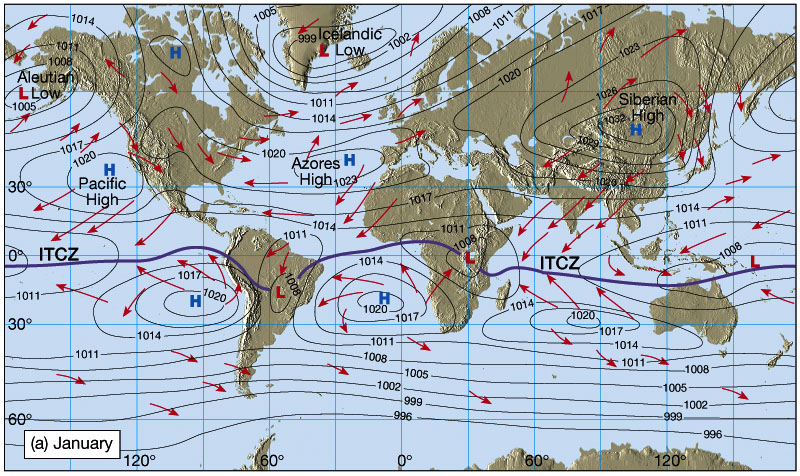
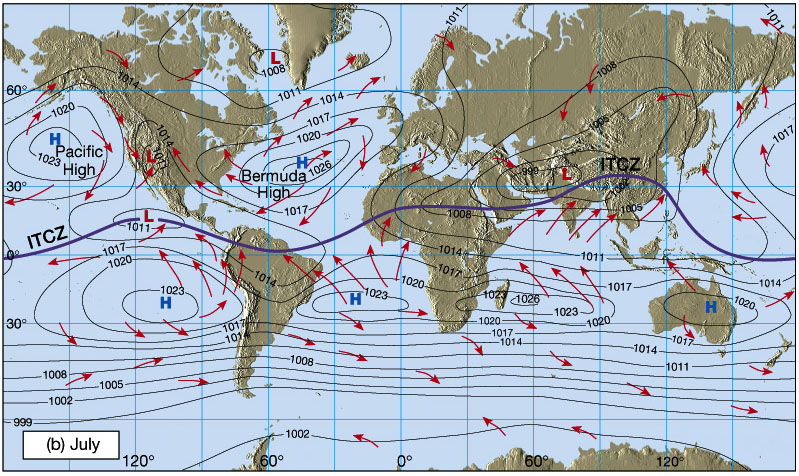
In India, this results in the onset of the seasonal rains, this dictates plant life, agriculture and water storage, and is not always reliable. It arrives at different times of the year, depending on how far away from the Western Seaboard you are, and can be mapped like this:


The Monsoon brings between 4 months and 6 weeks of intense heavy rainfall, and along with the UK climate, is your major case study of a climatic zone.

So, 5 rules, or key things to remember, and an excellent TV show to watch, the next episode is on next sunday, the 11th, at 9 on BBC 2 - put it in your diary!

Friday, 3 February 2012

Dantes Peak Volcanology Revision

Dear All

As a nice and simple way to ease you all back in to tectonics after the various challenges of Poole, we are watching Dante's Peak in class, and you have some revision questions based on the order of events in the movie. If you failed to complete them in class, or were absent, or if you are from one of other colleges following the Blog (Hello Queen Mary's in Walsall and thank you for the lovely email!), you can download the questions, watch the movie, and I will post the answers up soon.

Enjoy the movie, it is one of my all time favourites!
Dantes Peak Questions Enjoy not working on 4B!!

Monday, 21 March 2011

New Library Stock

Dear Geographers,

There are now some new additions to the Library which you may well like to check out. By request, the fantastic series "How Earth Made Us" is now in stock, it is a wonderful series for A-Level as it covers in great detail and with some fantastic graphics the earth and our relation to it, covering tectonics, rivers, winds and finally how we are now altering the planet as a result of our development and industrialisation.

This is most suited to the A2 groups who have now done tectonics and population and should be drawing the links between different areas of the syllabus. It is however and excellent geography show and will be a useful revision resource to everyone. In addition, Human Planet is now is as well and is another great way of exploring the links between our planet and the way in which we live.

You can find all the mentioned resources in the library, you may need to reserve some of our more popular titles, but there is a special geography display:


Not only movies, but also these old fashioned square-ish things called books that you read and learn from! Very strange concept to read for pleasure, but we do have both of the Al Gore books on climate change along with some interesting textbooks and novels.

In terms of movies, not one to check out for a relaxing evening in, but Darfur is the movie of the week, I have to warn you, I was hiding behind the sofa for a lot of this one, it is horribly graphic, but if you dont know about the Darfur crisis, take a look. It does not hold back on the gruesome details of the genocide that is currently taking place here. The movie is disturbing, but represents the horrors that rarely make it into our press.

You have been warned, it is a 15, but it is borderline to my eyes.

Check out the trailer here:


On a lighter note, WallE is in, recycling in a future world, and the revision questions to go with Dantes Peak will be on the display tomorrow - test your volcanology!

Tuesday, 8 March 2011

TV Top Picks - How to boost your grade through selective TV watching

Ok, well its a bit of an exaggeration, but this year is proving to be just fantastic for geography TV. Whilst there are some new classics (those of you in my classes have probably seen most of the Iain Stewart TV series relevant to our courses but there are loads more), here is my list, in preferential order, of the best TV you can access online or through the library that will broaden your geographical horizons:

1) How Earth Made Us

A fantastically geography orientated five part series, unfortunately not available online at the moment, but requested for the library. The five parts are Deep Earth, Water, Wind, Fire and People, and the aim of the series is to show how closely interlinked the location of our cities, our development or new ideas and technologies and our future is with the planet. Why do we live on fault zones? What attracted us there in the first place? Why are some of our largest civilisations at the feet of volcanoes, on tsunami prone coastlines and earthquake zones? How did a Southern Pacific shift in the winds lead to the elimination of a whole society - the Anasazi?

All this and more are answered, suitable for AS and A2 students, this documentary is a near perfect fit for our courses, the case studies are all relevant, and the breadth of knowledge contained within each show is an excellent example of how geography is not split into the physical and human, the two are inseparable, and interlinked, and the success or destruction of one, has a significant, and possibly devastating effect on the other.

Here's a taster from the episode on water (with a sneak preview of one of the many waterfalls we visit in Iceland!):


2) Human Planet

A little more of a tenuous link, but a series which has had me gripped from the start, not only for its astounding photography, the scenery is epic throughout (with the possible exception of cities), an the stories illustrated show how wide the range of adaptations we have made to our environments truly is. Narrated by John Hurts (Shooting Dogs) dulcet tones, the series covers everything from farming in the Rift valley and fighting off monkeys, to hunting arctic foxes with Golden Eagles, and using wild pigeon droppings in Fez to soften leather.


I think the funniest clip is the one below, from the final episode, this is the Elf in Estes in Colorado chasing some tourists who think they are tame!!


In a more geographical note, this series would work well for you particularly if you are doing either Environmental Studies or Biology, as it illustrates our symbiosis with nature, and how we have met the challenges of earths most extreme environments by adapting and finding solutions often based in nature. The episode on oceans was amazing, grasslands was fascinating, the Mountains was so fantastically bizarre I had to google it afterwards! Possibly a series of arguments to support the population optimists, whatever happens we will survive??

The series is available to view online through iplayer through this link, to me, some of the most interesting bits were the ten minutes at the end where they talk to the camera men about filming in these locations and far flung corners of the earht.

Human Planet - available until the 10th March or its arrival in the Library!


3) Slumming it - Kevin McCloud

This was on a couple of years ago, but as this is a geography blog I thought we'd have at least one purely human documentary in here! Most relevant to the population module, this was a shocking, touching, sometimes disturbing documentary about life in Mumbai's biggest Slum, Dharavi

Watch Slumming it - 4OD not available through the college system


Dharavi is massive, 600 000 people, squashed into 1.7 square kilometers, the main industry is recycling, small output factories and textiles. There have been many plans for redevelopment, all largely opposed by residents as the informal settlers would not be accounted for in any consolidation plans.

This was a two episode documentary, I have to say Kevin did a good job, the documentary shows the arguments for and against redeveloping shanty towns, and really clearly depicts life in a slum.


4) Drain the Ocean

Available to view on 4OD by clicking on the link below:


Drain the Ocean - Watch online (Not through college though)

This was a really interesting way of looking at the ocean floor, covering tectonics, coastal and mountain geomorphology and the degree to which tectonics has influenced our modern day landscape. The scale of the features within the oceans are astounding, mountains four miles high along the transverse faults, drops of several kilmoneters straight off the Bahamas banks, and a description of how they are formed by biological activity. The world with no water is a planet of vast plains, collossal mountains and rift valleys that dwarf the East African Rift. A lot of it is CGI combined with GIS, but this is useful in and of itself to geographers, especially as this kind of technology will allow us to accurately reveal landscapes formed during the last Ice age, yielding potential clues as to what to expect with future fluctuations in temperature.


This is a view of the Pacific with no water, Hawaii exposed as a huge range of mountains, towering far above the Himalaya if measured from the base. The link should be good for at least a month, an excellent documentary for global tectonics and students doing geology as well as geography.

5) Earth: The Climate Wars

I know, another Iain Stewart one, but this one has as real focus on climate change, it looks at evidence, prediction and reconstruction of past climatic events. This one is available to view online, on google videos

Episode 1 - Climate Wars

These three episodes cover an awful lot of the theory of the climate modele, this is an excellent resource for the current A2 module!


So, five TV shows you can access, there is no reason not to reach your four hours reading for the next few weeks! As soon as you've watched any of them, leave a comment to let others know what you think!

Monday, 7 March 2011

Aftershock - The Movie - Review


My Weekend movie was "Aftershock", a Chinese movie about the Tangshan earthquake of 1976. This movie received great reviews, and was labelled as one of the greatest disaster movies ever made.


The movie was the first big production IMAX feature to be made outside the US, and depicts the personal story of a young family whose lives are shattered by the quake. The earthquake traps the two young twins under the rubble of their apartment block, both are trapped under one slab, and the mother has to choose which one to rescue. I wont give away the key story here, but she does choose, and the film then carries on to show the effects of this up till the Sichuan earthquake of 2008.

In terms of geography, this movie very nearly had me in tears all the way through. The opening sequence showing the near total destruction of Tangshan was pretty horrifying, it seemed to focus on the variety of ways in which people can die horribly, and the scenes of the recovery effort are both realistic and heart wrenching, and the mother making her choice was enough to have me reaching for the tissues (I have been banned from movie choices for a while as I am depressing everyone else I live with! - Darfur,shooting dogs, oil crash, inconvenient truth - my movie taste does run to the apocalyptic side of things). However, the scenes of how we go about recovery and dealing with mass casualties, getting supplies into an area and why people remain living in very damaging regions of the earth were all good.

Overall, I liked this movie because it was realistic, it was a very human depiction of the chaos that big hazards bring with them, and the long lasting effects on the society which bears the brunt of the disaster. Well worth watching once I bring it back to the library tomorrow!

Sunday, 6 February 2011

Encounters At The End Of The World

This is possibly one of my most favorite films ever (After Harry Potter and Lord of the Rings of course), it was original, interesting and insightful, with fantastic footage and some quirky characters. It is however a documentary, made by German Filmmaker Werner Herzog, it documents the life of people living in Antarctica, based in McMurdo, the sort of make shift Capitol of Antarctica.


The film follows the stories of a few different groups of scientists who are working on Antarctica, and a few of the other characters such as the Bus driver, the random collection of travelers and survival trainers. The scientists are some of the most respected in the field of Glaciology, such as Douglas MacAyeal, whose theories on ice sheet disintegration we will study when we get to Heinrich Events (see the wikipedia page for a sneak peak of our last module here).

The interviews are a fantastic mix of the truly bizarre, including the lady who can fold herself up into a suitcase, and the out rightly terrifying perspective on radical climate change and the break up of the ice sheets, and giant icebergs, and my personal favourite bit, the volcanologists studying Mt Erebus which is monitored using the CCTV cameras currently employed in high security prisons!


The film clearly has an underlying message about the fate of the world, otherwise it wouldn't be on my list of movies to review, but it is also a positive movie, the scenery is just stunning, the wildlife is incredible, and for me the noises of the glacier and diving under the ice sheet were pretty jaw dropping (yes students, I know I am a nerd). The only thing i really didn't like, was how developed McMurdo was, my vision of Antarctica had always been of a pristine, unspoiled wilderness, but I was very wrong, it is in fact a small town, filled with people for most of the year, although their work is important, it slightly spoilt my mental image of the wilderness, and it left me feeling slightly sad that even Antarctica, vast and hostile though it may be, has been encroached so much by people already.

So, why is this a good geography movie? Firstly, it is just awesome, Herzog has made a very unique and fascinating movie, secondly, I have always wanted to go to Antarctica, and this is a very different view of the continent than presented in other movies about it. Lastly, it does in fact link to our syllabus quite a lot. The studies taking place at Erebus are useful tools for learning how to predict other eruptions, the Ice Caps are one of the most important things for us to understand in terms of future and past climate change, and are our most complete and accurate record for paleoclimatology over the last 600 000 years. You wont learn much about these things just from the movie, but as a good lead in to our final module in the Upper Sixth, you cant beat it. So, the Library have ordered it, and it will be there soon, let me know what you think!


Tuesday, 25 January 2011

The Cove


Already discussed in the Fish Fight blog, this was intended to be our cheery Christmas movie, but the snow got in the way and we lost too much time! (I blame global warming - sorry - Global Climate Change). This movie is now in the Library and especially if you are doing Environmental Science as well as geography, this should be a key film to watch.


Written and produced by the man who trained the original Flipper Dolphins, Ric O'Barry, whose aim is to expose the brutal killing of thousands of Dolphins in a Cove in Japan each year. The Dolphins are driven into a closed of cove, the best quality females are trapped and taken for training in dolphin sanctuary's and facilities across the world.

Whale Hunting is a part of Japanese culture, and the discussions surrounding the issue are well covered online, however, the slaughter of Dolphins depicted in the movie is shocking and it seems unnecessary. Dolphin meat contains high levels of mercury (Dolphins are apex predators and hence bio-accumulate mercury), it is donated to the school system, and few ocean populations can survive such significant hunts year after year. The Killing method in particular is brutal, and there are few reasons as to why the dolphins not captured are not just released instead of killed.

The movie is designed to stimulate its watchers into action, and it does so very effectively, there is some controversy around the information used and the people portrayed in the film, you can read about the reported controversy at wikipedia.

So why is this a good geography movie? It covers some key themes from the development module, the demand for holidays where you can swim with dolphins, visit theme parks with dolphin and whale displays etc is a product of both development, Westernisation and Globalisation, it is a high end holiday, a mark of being a developed nation with big tourist drawing power.

The trade in these dolphins is made possible through the spread of media, the Internet. exporting TV shows like Flipper, and the advent of cheap flights to where these facilities are. I am by no means saying that all dolphins in captivity have been selected in this manner, and certainly not advocating we release all cetaceans back into the wild, conservation through captivity is an important part of preserving our marine heritage, but this film does so accurately depict that the side effects to rapid development and significant economic gain are that some of the more humanitarian and environmental issues are readily overlooked when there is a market. The slaughter of dolphins can be done more humanely, those not wanted can be released. Japan is a developed nation, they do not need to rely on Dolphin meat to feed their population so why continue with such an aggressive capture and kill programme?

There is a positive to be drawn here that does relate to your geography studies, we are now in a position to bring issues like these to the forefront of global media, a positive to globalisation is that it is far easier now than ever before to expose practices like this and to effect change through social pressure. There are a number of websites that allow you to show your support, any one from any country in the world with access to the Internet can get involved (http://www.thecovemovie.com/ ), Westerners can access areas of the world like Taiji for research and protest purposes, the need for countries to maintain an eco-friendly public image is increasing by the day and using popular media like film to expose issues is becoming a powerful tool (see also "An Inconvenient Truth", "The 11th Hour", "The age of Stupid", "Sicko" etc).

So the Library staff emailed me on Monday to let me know we now have a copy, I will try and set up a viewing in a classroom on a timetable collapse day, but it is difficult, so check it out of the LRC, watch it and let me know what you think by posting a comment below!

Wednesday, 19 January 2011

Environmental Quality Assessments

Dear All

Today and yesterday the focus of my lessons has been the fieldwork options for the 4B paper, both of my A2 classes have been working on the same question, which was focused on primary data collection options. Although I did photograph the board with my iphone, and i have uploaded it (see below) to my blog, and the link will be on the Facebook page (I am always suprised by where IT has taken education since I left college - and thank you so much to the student who pointed out today I was probably educated with a chalk board), the photo actually wasn't that clear, and it appears some of you are overly reliant on IT as opposed to making notes for yourselves!


In short, the key points for a question on fieldwork were as follows:

1) Justify and explain your choice for data collection - we don't have the time to organize time off from college, staffing and to research a trip for this paper, the information is only released on the 1st of November and it takes time to sort out a trip for an entire year group. Also, we are dealing with a sensitive issue, and questionnaires need careful wording and experience of using them to be effective, sending them out without incentive for return will not yield results, and sending out poorly worded or potentially offensive questionnaires would not reflect well on any school or college they are linked to.


2) The Environmental Quality Assessment (EQA - not use of full name first, then subsequent use of abbreviation for the rest of the article/answer). Why have we chosen this method? Mostly because with the advent of advanced forms of Geographical Information Systems (GIS) that are also free - ie Google Earth - and provide us with up to date, high resolution images from the air, and in some cases a three dimensional image from ground level if Google Streetview is available. The EQA works by the user forming a set of criteria by which to assess quality, this needs to be defined clearly, You form five usable criteria, such as the quality of green spaces within the area, and having been in the lesson with the Ipad this week, you have all seen what kind of data we can get from Google earth. Some of the best suggestions from the two classes were the quality of the roads, the quality of green spaces, quality of housing and gardens. This is not necessarily enough to secure full marks, remember, all the marks come for JUSTIFICATION AND EXPLANATION - there are very few absolute right and wrongs in this paper, reasonable suggestions are all creditworthy as long as there is a suitable explanation! The very best answers include a sentence such as "for example, in order for green spaces to receive the highest score of 1, it should demonstrate a clear purpose, be accessible to the local population and clearly be well maintained, whereas a score of 5 would be awarded for areas that are unkempt, potentially dangerous with rubble or partially destroyed buildings and serve no clear purpose".
By doing this, you are demonstrating to the examiner that you actually know how to do an EQA! You know what is reasonable in order of gaining primary data from a secondary source such as Google Earth, and perhaps you have been prepared enough to try doing it!

3) Now you know what you are doing, how are you going to decide where to do it! Systematic, Pragmatic, Stratified or a Random sampling methodology? (Does anyone else always think of the song in the car workshop from Grease - It's systematic / It's hydromatic / Why it's grease lightning!) Again, there is no right or wrong, just a justification of which you think and an awareness of its limitations (see "What I learned in Geography This week" blog via Richuish Geography). You can link them together, ie perhaps a grid lain over the wards to be sampled on a scale of 500m between grid lines, and the the central point can be assessed, or the nearest point to that for which streetview, or a photograph on Google Earth would be available, a Pragmatically Systematic sampling methodology. Any answer is valid, just explain why!

4) You finally need to demonstrate that you have not just learnt a good answer and read a textbook, but that you  can think for yourselves and have a good idea on presentation, you have your skills booklet from last year, you could graph the results, map them and draw Isolines, draw proportional symbols on the map, divide into grids and shade in (a chloropleth for those of you who remember!).

Do remember, you don't have to do one point on the map, but could assess a small area,

The example EQA from the wednesday afternoon class was useful, I have retyped it below:

Green Space (Houses)
1 = Front and/or back gardens, well kept, no rubbish/rubble and well maintained borders
5 = Evidence of damage, rubbish/rubble clearly evident around the houses, lack of gardens

Community Green Space
1 = Purposeful, well used, well manicured, close proximity/easy access for population
5 = Unkempt, evidence of fly tipping, damaged structures, poor quality scrub vegetation

Roads
1 = Good Surface, clearly marked, no plants growing in the roads
5 = Potholes, unmarked edges and central lines, overgrown roads and pavements

Quality of Housing
1 = Solid, well maintained roof and intact windows on all buildings, garages and/pr parking clearly available
5 = Collapsed or damaged roofs, evidence of vandalism/damage, empty properties

This is not meant as something for you all to learn, and i certainly would not expect you to repeat all of it in an exam, but it provides a useful template for developing your own ideas and EQA.

Once again, your language needs to be geographical, for those of you that struggle, forgive the poor language (and appalling spelling - sorry the Ipad is pretty but it doesn't automatically spell check!), but you need to "geographerise" you answer, think what you want to write, then think what words you have learned that are of relevance to the answer and try to work them in.

Hope this helps, tomorrows post will include my finalized list of essential words you need to work into your answers.


As discussed with some of you, and mentioned in my blog on Tuesday, my geography film of the week was "the age of stupid", partly chosen as we will soon be starting our final (sob/eek!) module - climate - and partly as Pete Postlethwaite, one of my favourite actors, passed away recently.

The movie is an alternative to "An Inconvenient Truth", which I know most of you have seen at school (if not, its in the library - check it out), but it is a very factual movie, and does of course have a political slant to it (surprising that). "The Age of Stupid" is set int he future, 2055, and is one man (Postlethwaite) taking a retrospective slant on why we were so blind to the signs of environmental change (note the new terminology - global warming is too confusing - go figure) that are happening with ever increasing frequency. Postlethwaite has access to all archive footage from news channels (all real) that portray the worst climatic events of our time, and the increasingly regular occurrence of extreme weather events. He reviews the NIMBY's who "care" about climate change but dont want a wind farm in their village, the oil industry worker who lost everything in Katrina and the family "doing their bit" in the countryside. Was it enough? No. Postlethwaite's world is post-apocalyptic, we are flooded out, starved, out of resources and out of time to find new ones.

I enjoyed the movie, it didnt break any new ground in terms of the science, and is by no means a replacement to learning the theory, but as an introduction to the issues and to give an excellent view of "different perspectives on the issue" (something our exam board are exceptionally keen on - take note), it cant be faulted. Why are we so reluctant? Because we like our lifestyle, other countries want our lifestyle (Westernisation/Americanisation of culture), the only way to get it, is to use fossil fuels. They took millions of years to form, their formation changed our climate into the nice low carbon one we know today, and yet we burn through this resource like we can make more of it when we want to. Wake up folks, we cant! But that's a discussion for another module!

Overall, well worth the 90 minutes it lasts for, I doubt that we will have time to watch it in class, but there is certainly enough time for you all to check it out of the library for a night or watch it in a free period in the library - that is of course after I remember to return it tomorrow!

See you all in class!

Tuesday, 18 January 2011

Fish Fight

As many of you have also done over the last week, tonight I watched the full Fish Fight series (available on YouTube shows until the end if January). Although I was already aware of the issue from some other films and reading about the issues surrounding fishing in thus country, the footage shown of by catch and discard was truly haunting. Hugh's enigmatic, passionate and informed discussion of these issues is enough to make anyone think twice before buying fish, and to make sure we read the labels.

You will all soon be catering for yourselves, you are the next consumer generation, we have a responsibility to show retailers that we want sustainable food in our supermarkets.

Hughs Programs are available on YouTube Shows, but for those of you who havent discovered this growing area of YouTube yet, the campaign video is here


Links to the shows are found through the link here to the series which is available until the 12 of february

http://www.youtube.com/show/hughsfishfight?s=1


In addition, there are some other fantastic movies that are on a similar theme, perhaps more useful to students who are taking Environmental Studies as well, but if you were disgusted by the Shark finning on Gordons "Shark Bait" last ngiht (link here: http://www.youtube.com/verify_age?next_url=http%3A//www.youtube.com/watch%3Fv%3DeS775jXFlgA%26feature%3Dchannel though you must confirm you are over 18 as there is, of course, explicit language), you really should check out "Sharkwater", useful for looking at the downside to rapid development and globalisation of trade, this movie documents the Shark Finning industry in Costa Rica, ending in an armed chase away from the coastline and public outcry at this truly shocking treatment of our oceans predators.


On a similar note, "The End of The Line" narrated by Ted Danson is another excellent expose of just how dire the situation in our oceans is, with scientists predicting a significant collapse of the fishing industry by2048 unless we take action now


Lastly, every been swimming with Dolphins? Ever watched Flipper or been to an Aquarium with a Dolphin show? This movie is written and directed by Ric O'Barry who trained the original Flipper Dolphins, be warned, it is not for the squeamish or fainthearted, but is essential viewing for any doplhin lover.