Showing posts with label Global Climate Change. Show all posts

Monday, 5 March 2012

Atmosphere and Circulation help

Dear All


Our current topic (Climate for those who dont go to Huish!) is widely accepted to be a little bit challenging, so I thought a special blog post on how to learn about this in a different way might be appreciated. So, first of all, a recap on the most basic rules of circulation in the atmosphere, if you dont want to read, the BBC have produced a really outstanding TV show, called "Orbit" which you can watch here, I would consider this a really excellent way to spend an hour, as it makes the entire start of the module easy and is very visual. They even have a blog centre for more reading, but in the mean time:

1. The spin of the earth:

Earth spins towards the East, if you are attached to the surface (Continents, people, trees etc) then you do not feel this effect, but, for all gases and liquids, the spin of the earth to the East, deflects surface flows towards the West. Hence, all ocean currents, surface winds, hurricanes, are pushed to the west. If the earth did not have any continents, the oceanic currents would just move around the globe, from east to west, but, the continents complicate the issue, and force ocean currents to deflect North, in the Northern Hemisphere, and South, in the Southern hemisphere, along the Eastern edges of the continents.


2. The tilt of the earth:

We tilt at an angle of 23.4 degrees away from an imaginary line that is perpendicular to our orbital plane. Our tilt, or obliquity, does not alter as we move around the sun, therefore, over our summer time, we are tipped towards the sun, summer starting during the spring equinox, through to the summer solstice and on to the september equinox, when we enter winter, as we start to tip away from the sun, reaching our maximum distance, during the winter solstice, or as you may know it, as December the 22nd.

This tilt, is what brings us the seasons, and what causes the ITCZ to move over the course of the year.

3. Convection:

This really is a key concept in Earth Sciences as a whole. The basic principle, is that anything hot, rises, until it hits an impenetrable layer, at which it must split, and flow laterally along this boundary, loosing heat to its surroundings as it does so. Once cold, it must sink, as it has become more dense, it then hits another layer, and diverges, some goes back to the source of the heat (where there will be a vacuum as material is constantly rising), and some heads in the opposite direction.


You have come across this before:


Once you factor in the 3D nature of the planet, and the atmosphere, along with the fact that we are so big, the cells are split into three, you have the global circulation model:
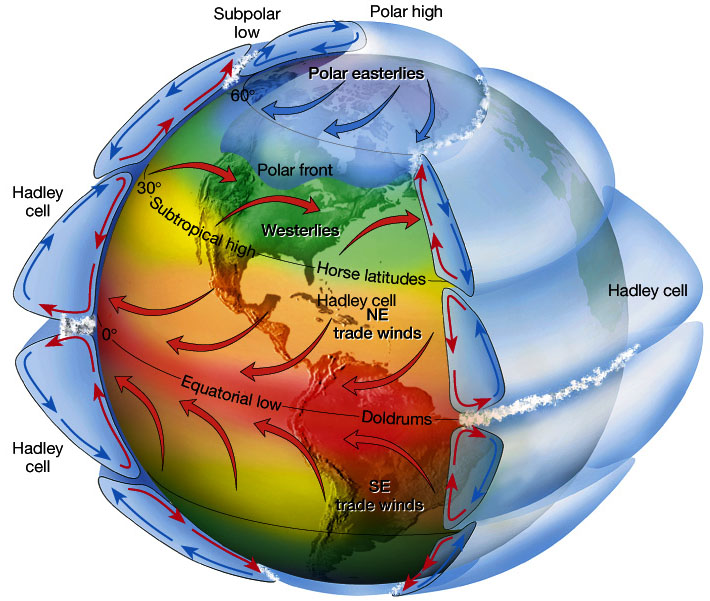
4. With or against Coriolis?

The Coriolis effect, is just the name we give to anything that is affected by the spin of the earth, you have come across it with tides in the Lower Sixth. The key principle to remember, is that anything that moves towards the equator, is slowed by the Coriolis effect, and therefore is always deflected to the West. If the opposite occurs, if a movement of liquid or gas moves towards a pole along the surface, it is boosted by Coriolis, and moves with the turn of the earth.

This means, that winds in the Ferrel cell, on the surface, blowing towards the poles, blow from the SW up towards the poles (Or down, if you are below the equator).


If we are talking Jet streams and Rossby waves, this difference in speed is what controls the path of Anticyclones and depressions beneath the junction between the Ferrel and the Polar cells. These regions are often referred to as the Horseback latitudes. Hence, when the meanders on the Jet stream (which we call Rossby Waves), start to head towards the equator, they are slowed, and therefore pressure builds up in the upper Atmosphere, and all the excess air has to start moving downwards, ie towards the surface, this is what is found in the ridges of the waves (Closest to the poles), whereas in the troughs, the air starts to accelerate towards to poles, leaving behind high altitude low pressure, therefore, to fill the void, air has to be sucked up from the surface, creating a low pressure system, more commonly called a depression:


Trough: pressure is lower in a trough than to the west and east
Ridge: pressure is higher in a ridge than to the west and east

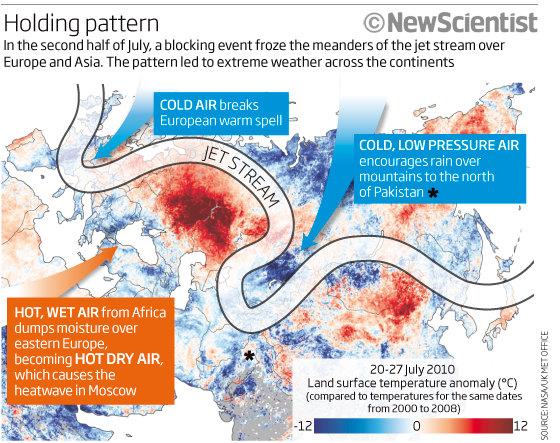


There is an excellent animation of this on the TV show recommended. This passage can sometimes get stuck, as happened in July 2008, and December 2010, as this diagram explains:


5. The ITCZ:

This is the driving force, which starts the tri-cellular model, the ITCZ stands for Inter Tropical Convergence Zone, literally, the place where the surface winds of the Hadley cell come together, and where the most intense heating of the earths surface takes place. It can easily be seen on most satellite images:


It is not a straight line, none of the boundaries between the cells are, and it moves as the earth rotates around the sun. In our winter time, it is more southerly, and over our summer time, more northerly. Where it crosses continents that sit beneath the two extremes, it causes a seasonal reversal of the winds, and this change, brings about the Monsoons:
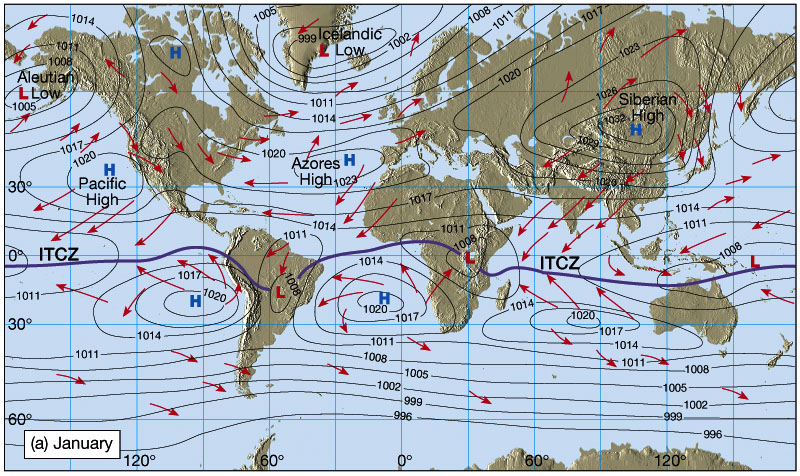
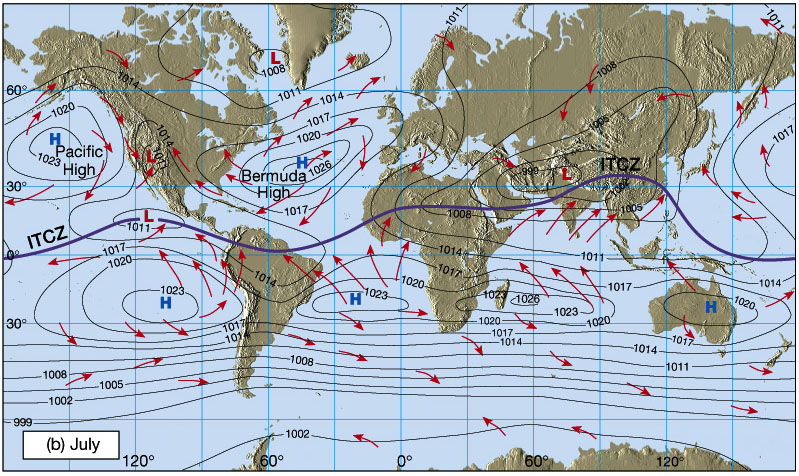
In India, this results in the onset of the seasonal rains, this dictates plant life, agriculture and water storage, and is not always reliable. It arrives at different times of the year, depending on how far away from the Western Seaboard you are, and can be mapped like this:


The Monsoon brings between 4 months and 6 weeks of intense heavy rainfall, and along with the UK climate, is your major case study of a climatic zone.

So, 5 rules, or key things to remember, and an excellent TV show to watch, the next episode is on next sunday, the 11th, at 9 on BBC 2 - put it in your diary!

Thursday, 15 September 2011

Climate Change comes to Somerset? (Oh no, not the Cider!)

Welcome to the first post of the year! A summary of recent climate change activity, and the potential dangers to a somerset tradition.

This year has seen a flurry of discussion about how climate change, and the Rio +20 summit (Rio Earth Summit 20 years on, Kyoto runs out next year, leaving a gaping void in binding climate agreements), and the general consensus seems to be that the way to get people to listen on the climate change front, is to tell them that it will hit them where it hurts. Their wallets.

Much research has been done since the Stern Report on the impacts of climate change, and governments all around the world are starting to see some changes. We have had two extreme winters, costing many millions in repairs to roads and infrastructure, Hurricane Irene reached New York, unusual for Atlantic Hurricanes, and Africa is gripped with one of its worst droughts on record. This month has seen the start of a geo-engineering trial, the SPICE Project (Stratospheric Particle Injection Climate Engineering), which is in the early stages of testing, and over the next few months the kit will go through field trials with a kilometre long hose and Helium balloon spraying water at altitude, with an aim to identify three key issues surrounding the highly debated idea of geo-engineering (reproduced from: http://bristol.ac.uk/news/2011/7895.html):


Evaluating candidate particles: Researchers from the Universities of Bristol, Oxford and Cambridge and the Rutherford-Appleton Laboratory are considering what would be an ‘ideal’ particle to inject into the stratosphere.  The researchers will aim to identify a particle with excellent solar radiation scattering properties, and consider what potential impacts might be on climate, weather, ecosystems and human health.
Delivery systems:Engineers from the University of Cambridge and Marshall Aerospace will test the feasibility and design of using a tethered-balloon to inject particles into the stratosphere. They will be using the data obtained from the test-bed project in computer models to examine how a full-scale system might work at an altitude of 20km.
Climate and environmental modelling: Researchers from the Universities of Oxford, Edinburgh and Bristol are working with the Met Office Hadley Centre to consider what can be learned from past volcanic eruptions.  They are also modelling the potential impact on ozone layer concentrations, regional precipitation changes and atmospheric chemistry.
SPICE is funded by the Engineering and Physical Sciences Research Council (EPSRC) and the Natural Environment Research Council (NERC), with support from the Science and Technology Facilities Council (STFC) who are providing laboratory facilities and expertise for the project.


The full article is well worth a read, and will be useful for our final module this year.


For those of you still debating the idea of manipulating the climate system, against taking radical political and economic action to reduce our carbon emissions, here is an excellent blog post from todays Guardian, by John Shepherd, part of the comprehensive section on all geo-engineering issues that can be found here. 

Some countries are already considering preventative measures, Kiribati was in the news this week for their contemplation of a radical scheme involving the creation of artificial islands , that their vulnerable population could relocate to. The scheme proposed by Vincent Callebaut, the Lillypad  scheme, images below, would see vast floating islands holding hundreds of people each and capable of handling the coming challenges of global climate change.


Extreme though this sounds, the idea is feasible and as Kiribati is already facing a $900 million bill for protecting its infrastructure, against a $2 Billion bill for constructing an oil-rig like structure to house several hundred people, the economics are becoming more justified with every centimetre rise in sea level. Artificial islands are in fact, nothing new, several have been built over our history, some more famous than others, such as the controversial Palm Islands and the World in Dubai:


On a smaller scale, the floating villages of Lake Titicaca are older and still in use to house the Uros people, there are believed to be around 40 of these islands anchored in the lake, very few accept visitors, and the Islands anchor them using long poles to reach the lake bed. Other island states have started to construct "Rubbish Islands" such as Thilafushi in the Maldives, which has been controversial, but perhaps the only way to handle the 3.5kg of waste produced each day by tourists who now number over 100 000 per week to the islands. Semaku is the island cretaed from nothing but open water to hold Singapores rubbish, which is incinerated or rcycled, then compressed into vast ocean based chamber, and now is a recognised nature reserve and mangrove swamp, and a tourist attraction for the city state.


So, this year should prove to be interesting, you would be well advised as aspiring geographers to keep abreast of the developments at Rio +20 the official website is here, and here is the link to the Guardians coverage of the event which will develop over time, so keep this link handy!

So, you ask, how does any of this affect us in Somerset? If you have been saying to yourself, or heard many others say, that this winter was so cold, how can global warming possibly be happening? Or, even better, as someone recently said to me "Yes thats all very interesting, but that sort of thing doesn't happen here", a little story about the weird weather this year, and how it could potentially affect our most precious of Somerset exports, cider.

You will probably remember, that spring this year was rather lovely, early and very hot, we had a fantastic easter break, short though it was, and all enjoyed a sunny Royal Wedding (See my earlier post on Royal Wedding Geography). Summer has been ok, not too hot but you may have noticed we have an abundance or soft fruit, and apples. No bad thing, for a county that still exports a lot of cider, but the trees are a little confused. Having blossomed and fruited early, they are not putting out their winter buds, normally not seen until the leaves drop later in autumn. The problem here, is that should we have a tradition "Indian Summer" late in September or October, as has happened for the last two years, the trees could start to put out new leaves again. When the winter finally comes, and judging by the last two years, it will be cold, the trees may suffer some fairly serious damage. Combined with the fact that a common sight at the moment, are apple trees breaking under the weight of their bounty this year, the increased tree damage, and potentially confused buds, could leave us in an awful position next year, as in, we may have a cider shortage.

Dont panic yet! If the winter stays cold, we could be ok, the trees will be fine, and come spring, we might have another great year for our apples, but we could be missing some of our small mammals and birds that depend on autumn fruit like Hawthorn and Elderberries, both of which are already fruited and going over, or Rosehips, which traditionally last till november. Even the Holly is coated in berries already, so when it gets cold, and food gets scarce, there will not necessarily be enough to fatten up hibernating or migrating species before the long winter.

What can we do about it? Well, firstly, do your apple trees a favour, and pick some fruit off the heavily laden branches to prevent too much damage, secondly, we may all need to provide a bit of grub for the birds later on in the year, last, but not least, enjoy this years apple crop, next years may not be any where near as good.


Lets hope that this doesn't happen, but the signs of coming climate change are all around us, having never had a day off for snow when I was at school or college, over the last three years I've had the better part of two weeks snowed out of work, remember, climate change does not mean we are just going to get hotter, we will suffer more extremes of temperature and shorter, more extreme seasons. Sound familiar?

Sunday, 16 January 2011

Welcome to my Geography Teaching Blog!

Hello!

This is the first of what will hopefully be a read-worthy blog for the rest of the academic year, it is linked to my Facebook Page - Richuish Geography, and for those of you who havent sussed it yet (hopefully that doesnt apply to my students) I am a Geography teacher!

This blog will be filled with updates on what I hope i have achieved in me A-Level classroom this week, and interesting things I read and think about geography and geology as and when I read or think them! This week, is the final week of the Skills exam for my lower sixth, and the Belfast unit for my upper sixth, who have had their pre-release material since november, and only have to immerse themselves in Belfasts history and development for another two weeks! I feel sure many of them are counting down the days - if thats you, attend the event on the facebook page and share your feelings about Belfast, and preferably any exciting links or resources you have found

This weekend, what has mostly been fascinating me is the new eruption at Mt Etna (see above), I do love my Sicilian volcanoes, and Etna is one of my favourites, i have been many times, three of them with college (we have an unfortunate/fortunate habit of stopping volcanic eruptions by just arriving in the country!), and this weeks NASA Earth Observatory Photo was just stunning (Takes a while to load - http://earthobservatory.nasa.gov/images/imagerecords/48000/48612/etna_tmo_2011011_lrg.jpg) The video foottage showed some fabulous fire fountains, and once again the Sicilians show they are well on track with volcano management, close the airports, divert the flights and then clean up!

Lovely stuff, almost as good as the footage from Vanuatu last year, but I'll save that for another blog. Also on my reading list this week, the horrendous flooding in Brazil, Australia and Sri Lanka. The La Nina effect is in full force this year, shame it is not on the syllabus, but unfortunately we no longer cover El Nino/La Nina oscillations.

Lastly, is a small whinge on my part, if i hear one more person tell me that it was so cold this winter global warming clearly is happening I will start a public service of street lectures on why they are so wrong! Students, climate is our next module, and we do have a lesson called "skeptic bashing" which is a game where you score points for effectively countering common misinterpretations on global climate change - get your best response to that one prepared!