Dear All
In an effort to be exciting and dynamic with our teaching of 4B, here is a word cloud visualising the most common terms used in the AIB booklet. It may be useful to consider which words appear most frequently!
Millie
Thursday, 26 January 2012

Monday, 23 January 2012
Last Minute Live Revision
Dear Lower Sixth!
Tonight there will be e revision session online, here starting at 7:30 incase you have any last minute questions for tomorrow. You do not need to create an account, just submit your question in the box at the bottom, and wait for me to type a reply! (if it is a long reply be prepared to wait a couple of minutes).
Tonight there will be e revision session online, here starting at 7:30 incase you have any last minute questions for tomorrow. You do not need to create an account, just submit your question in the box at the bottom, and wait for me to type a reply! (if it is a long reply be prepared to wait a couple of minutes).
This is a "Silly Question Amnesty" so please ask anything, even if you feel we have covered it before, and bear in mind I have control over publishing your posts, so whatever you submit will not appear immediately!
See you all soon, you can submit questions from now on (18:46) but I am just grabbing some dinner first, so they will be answered later.
Millie
Saturday, 21 January 2012
Apps for revision
Dear All,

Ask yourself the question, click the circle to reveal the answer:

In order to find my classes:
- When you create your account, the site will ask you where you study, type in "Richard Huish College"
- Search for "Millie"
- Select "Geography Geog AS"
- Go back to "my Backpack" (top center left of the page)
- In the class, on the right had side there is a news pane, this will show who else is in your class, and when any new resources are added. You should be able to find the resources in here, click on them in turn, and on the right hand side, select "Save to backpack/ Geography Geog AS" this will make them accessible on your phone.
Currently in the StudyBlue.com Geography class, there are apps for population and rivers terminology, and one for skills, with pictures of all types of graphs and stats tests you could be asked on tuesday, the case studies have pictures, and you can use them as flashcards to test yourself, or each other, and on the website, the flashcards can be turned into self marking tests. The site tracks your progress for each set of cards, and produces a score per session. You can then filter the cards out, and just revise the ones you didnt get the first time if you upgrade to studyblue+, but the site offers fantastic functions for free!
You then need to download the App (StudyBlue) from the relevant App store, or follow the links at the bottom of the page. The App is free, and once you log in you should find the flashcards there waiting for you. Any problems let me know, but you can then start revising.
There are several ways to work, and you do not need a smartphone, either on your phone or computer, check yourself for each card, and if you got it right, give it a thumbs up, if not, select thumbs down, and revise it again later on. When you log on to the site from a computer, you will be able to see how well you have done, and transform the cards into a test by clicking on the "Flashcards" tab as shown below. The questions are multiple choice or true/false, avoid the "Type the answer" questions by unselecting at the top left, and regenerating the quiz:

(Ignore my 3%, I had only done one!)
The quiz then looks like this, be warned, they are pretty difficult!

You can work online in exactly the same was as on your mobile, but only the online version offers you the quiz version. The quizzes are good, and there is an option to change the question style at the top left. You can track your progress online, and if these are useful, I will write some more over the next few weeks to help with the new modules.
Please let me have feedback, I know it is close to the exam, but these would be handy for last minute revision, and as they work on your phones/iPods without an internet connection, just think about all the fun places you can revise such as the bus, the coffee shop, etc, in fact, send me a picture on the Facebook Page of you revising in an unlikely place to win a small prize.
Dont forget the online revision tomorrow, and have a good weekend!
Millie
PS. DIrect links once you have an account:
Rivers Terminology: http://s.tudy.it/twlnsp
Population Terminology: http://s.tudy.it/twlnsp
Skills Test: http://s.tudy.it/twzznk
Friday, 18 November 2011
El Hierro - The Birth of a new Island?
In a timely fashion, just as we start volcanoes in geography, and geology AS, a new island is forming off the coast of the Canaries! This is a rare event, still in its early stages, but well worth following over the coming weeks!
So, the basics, El Hierro is the name of the most westerly of the Canary Islands, long considered by early Europeans to be the end of the world, is is a mountainous and volcanic island formed 1.2 million years ago, and with the largest number of volcanic centres of any of the canaries, totally over 800 identified to date. It is under 300 km2 in total and only one eruption has ever been recorded on the island from the Volcan de Lomo Negro vent in 1793. The eruption lasted a month.A series of landslides have lowered the height and reduced the size, the highest point is now 1501m above sea level.
.

So, what has started in El Hierro is a new Surtseyan eruption, just of shore of El Pinar, a new volcano has been spewing lava and ash into the water column, along with a range of noxious gases. It is however, quite incredibly beautiful:


This satellite image shows the blue-green swirls of volcanic particles and ash mixing with the waters to the west of the Island, the three red dots, circle the epicentre of recent earthquakes on the north coast of the island (image belongs to the NASA Earth Observatory website):
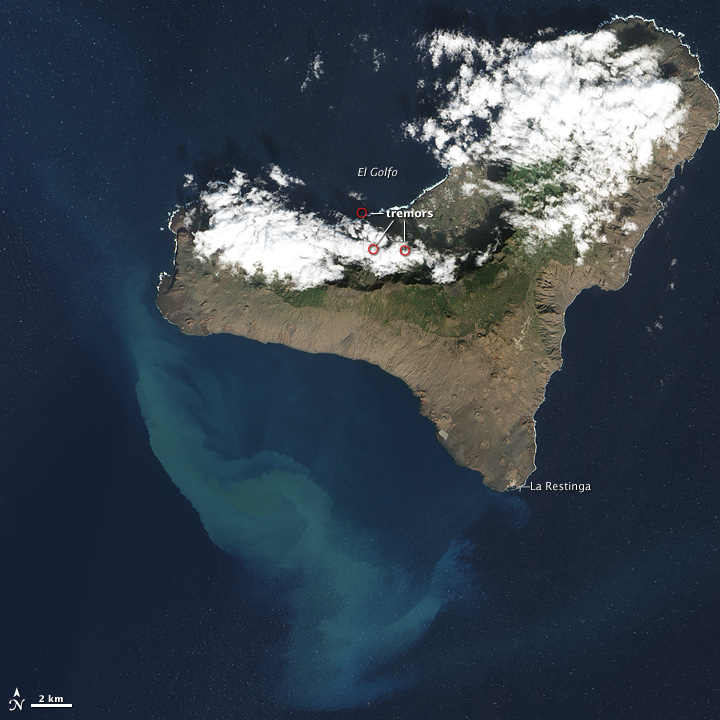
So, what does this mean? Well, the eruption is unusual, as it has persisted for nearly three months, and it could continue and break the surface and become subaerial. At the moment, it is a typical Surtseyan style eruption, named after the Island of Surtsey, part of the Icelandic Rift system. This island formed in 1963, with eruptions persisting for three years, and giving its name to the "Surtseyan" eruption style. The initial phase was similar to El Hierro, but the Island of Surtsey was only preserved when the eruption ceased to be Phreato-magmatic, and lava sealed the surface to ensure the Island will be around until at least 2100. This is a new word for many fo you, a Phreatic eruption is one where the explosions are created by water interacting with the eruptive centre and producing stea, which drives a violent eruption of volcanic fragments and ejectiles. Phreato-magmatic, is where the volcano produces magma, which creates a violent eruption, often producing large eruption columns, and common in any sub-marine eruption in the first phase. Once the Island of Surtsey had breached the surface, and built up enough height to overcome the interaction with waves, the eruption style changed to a more typical basaltic eruption with fire fountains and small lava flows, creating a more stable island, that would resist the onslaught of the North Atlantic waves (You can read a summary of the eruption here). There is also an excellent article written by Erik Clemetti, an assistant Professor of Geology, on Hydro Volcanism with a thorough explanation of water/Magma mixing and some great case study pictures.
Back to El Hierro, the future may be shortlived, possibly only a few years, unless lava breaches the surface of the sea and builds an Island. In which case, it would be likely to follow the route of Surtsey, where subsidence into the crust, and erosion would lower the height, but build coastal depositional features such as this Spit that has been built at Surtsey over the last 50 years:

The island is now a UNESCO world heritage site, and has been studied since it first broke the surface yielding volumes of information about the rate of succession taking place on the island. There are now 30 established species, 69 have been counted in total, and 2-5 new species a year are introduced through a combination of driftwood, bird Guano and travelling insects. A soil has started to form, and the island is home to many seals, and hence regularly patrolled by Orcas. Over time, the island will erode, leaving behind a magma chamber, which will be more resistant due to slower cooling, and the island will eventually look like one of the many other small islands in the Vestmannaeyjar (West Man Islands), of which Heimay, which you have studied and some of you will be visiting, is part:

In a recent update, another island has been born in the Red Sea, the small group of islands owned by Yemen, known as the Zubair group, saw a new island breach the surface in December, information is still sparse, but this is part of the rifting process beneath the Red Sea, that extends through the Rift Valley, and is infact a stage or two further along in the Wilson Cycle than the Rift Valley is at the moment:
So, two new islands to keep an eye on over the coming months, as well as highly speculated and potentially catastophic eruption of Katla (remember Icelandic volcanoes are seasonal, they like to erupt in spring when isostatic pressure is relieved by the ice melt, and creates space in the magma chamber, which theoretically can destabilise the volcano). Icelanders refer to both Hekla and Katla as being "Pregnant" or heavily overdue in terms of eruptive frequency, so watch this space! (Or, more accurately, European airspace).
Tuesday, 27 September 2011
Live Aid and LDC's
Dear All
as a summary to the work we have done so far this year on LDC's and the reasons for current levels of development, I though some persepective would help you to place our current studies in context.
Many of you will have heard of Live Aid and some of you may have even been one of the 3 billion people who in 2005 watched one of the 10 live concerts, but how much do you really know about the cause, the history, and the success of this unique campaign?
To start, the originl Live Aid was broadcast in 1985, following the release of the Band Aid single, which in case you havent heard it, here is the original:
Formed in 1984, the single was released on 25th November 1984, but re-recorded in 1989 and 2004, topping the charts each time, and is so named as a play on the name "Band Aid" or the plaster company, and is a little self deprecating as the artists at the time recognised that monies raised are like using a bandaid to stem a major wound. Each time this British/Irish super group formed, it collected leading artists of the time, and estimates out the amount of money raised from november 1984 to January 2004 as £75 Million.
A summary of Band Aid charitable activities till 2004
The Live Aid concerts took place the year after the release of the first single, taking place on three continents, and countless countries. But to understand why, in a time before the internet and email, live streaming and Facebook, whose idea was it, and why did it happen?
The answer can be seen by watching any news broadcast of the current crisis in East Africa, but one report, by Michael Buerk, highlighted the famine of 1984 more clearly than any other, and had a profound impact on the coverage and attention the crisis received. It was one of the first, and certainly one of the most emotional, and remains to this day, some of the most moving news footage on record:
So, what was Live Aid? A collection of the best and brightest artists performing in Philadelphia and Wembley, with Concorde on standby to chauffeur Phil Collins from the first concert in London to play in the second. My favourite from the performance, the everlasting, enigmatic and energetic Freddy Mercury, with a fabulous performance:
The freddie Mercury Tribute Concert:
Sunday, 25 September 2011
Hello Upper Sixth!
In time for this tuesdays session, here is the ticker for you to submit any questions about the subtopic of LDC's and the Millenium Development Goals. The live audio feed will start at 530, hopefully with some better quality broadcasting on my part!
All questions will be answered on tuesday night, we are about to move on from LDC's to the issues surrounding globalisation and developing countries and further case studies to include India and China, South Korea and a carefully selected TNC. In the meantime, keep your eyes open for a post regarding feminism, following the shocking views of some of my upper sixth classes, and the notes from the video on Globalisation. See you tomorrow, with your completed essays, ready at the start of the lesson! Millie
All questions will be answered on tuesday night, we are about to move on from LDC's to the issues surrounding globalisation and developing countries and further case studies to include India and China, South Korea and a carefully selected TNC. In the meantime, keep your eyes open for a post regarding feminism, following the shocking views of some of my upper sixth classes, and the notes from the video on Globalisation. See you tomorrow, with your completed essays, ready at the start of the lesson! Millie
Thursday, 22 September 2011
Equality Across the World, and yes, we still need it.
Dear All
Following the discussions held in many of my A2 classes this week, don't worry I shalln't name and shame, I felt it was time for an imaprtial assessment of how closs to true equality we are across the globe, and a reasoned, written response as to why it is. in fact, considered to be one of the driving forces behind development, and on of the largest challenges we face.
Don't worry, this is not a feminist rant, merely a subjective (well, mostly) review of the current statistics, and an explanation as to why so many of the MDG's focus on equality for women.
The womens rights movement, started in developed countries in the late 19th century, and most of you will have heard the term "Suffragette", whilst "Suffrage" means the civil right to vote, it is a term that has become linked to the granting of votes to women. New Zealand, was in fact the first country to afford women the vote in 1893, whilst in the UK, the "National Union of Womens Suffrage Societies", founded in 1897, and spearheaded by Millicent Fawcett led over 20 years of peaceful political campaigns, (Wo)mannedlargely by the UK Middle class. It is worth noting, that the Womens Social and Political Union, was a separate, and more Militant offshoot of this organisation, who wanted more action on womens votes, and was headed by Emmeline Pankhurst.

The suffragette movement has attracted much speculation over its course of action, but the sacrifices made by these women should not be underestimated. Pankhurst was arrested 8 times, and staged hunger strikes in Royal Holloway with other WSPU leaders, which led to the practice of forced feeding of women prisoners in 1912. She continued to campaign, and support the policy of property destruction and activism, which led to many fo the original members of the WSPU leaving the organisation

To start, we have had legislation in the UK for 41 years, making it illegal to give preferential treatment to either one of the sexes. Ms. Fawcett said in a speech in 1911 that their movement was "like a glacier; slow moving but unstoppable".
So, how does any of this affect development? Quite simply, it is the "Girl Effect" and here is a video from the charity promoting the issue, which sums up the problem far better than I can:
In terms of factors that affect fertility and mortality, we have covered the idea that the more control and education a woman has, and importantly the more access to family planning and contraceptive materials we have, the later they will have their first child, the more they contribute to the workforce, the tax base and the politics of their country.
This leads us to the question, which countries are leading the way, and who is falling behind with regards to Gender Equality. Here is one of my favourite images, a complex graph, but one that relates the ratio of earnings, and the percentage of seats held in parliament:

According to the 2006 statistics, Sweden is the country with the highest degree of equality, women earn 85% of male earnings, and occupy just under 50% of the seats in parliament. In contrast, Oman, the UAE, the Sudan, Eqypt and Morroco have under 25% of their parliamentary seats held by women, and they earn on average, 25% of equivalent male salaries. There are some suprises here, and of course some significant uprisings since this graphic was produced. Kenya has few female politicians, but women earn 80% of a typical male salary, whereas in Rwanda, over 5% of places are held by women, and the earnings ratio is 0.70.
Fascinating stuff, but in a country like the UK, where it is illegal to discriminate, and we were one of the first to give women the vote, and legally, a woman can do the same as any man, why are we in the middle of the pack? Women in the UK earn less than 70% of their male equivalents, and hold 15% of parliamentary seats. I wonder what Emeline Pankhurst would think of this?
Subscribe to:
Posts (Atom)